You might be eyeing film school right now. You’re visualizing a future spent in a trendy café in Toronto or Vancouver, sipping an overpriced latte, wearing the requisite beanie, and debating the cinematic nuances of The Godfather.
Or perhaps you’re already enrolled, watching your student loan balance swell faster than a summer blockbuster’s opening weekend returns.
Even worse, maybe you’ve already graduated, and the closest thing you have to an "industry contact" is the shift manager at the cinema where you’re currently pouring sodas.
Institutions like York or U of T are exceptional at teaching film history and theory. They are wonderful for building a deep appreciation of cinema as an art form. But there is a glaring gap in their curriculum: they don’t teach you the business of actually selling what you write.
These programs often operate on the naive belief that pure talent always rises to the top, completely overlooking the exclusionary, complex machinery that drives the real-world film industry.
In 2026, the film business operates less like an art museum and more like a high-stakes investment bank. Studios and producers aren't hunting for "art" in the abstract; they are hunting for financeable intellectual property. They are entrepreneurs building complicated financial stacks involving debt, equity, and tax credits. Your script is simply the foundational asset that determines if that stack holds up or collapses.
To succeed today, you must stop thinking like a keener student and start operating like a supplier. A brilliant idea is not enough—in Hollywood, ideas are practically free. Everyone you meet, from your Uber driver to your barista, has a "great movie idea". To actually break in, your expensive degree means nothing. What you need is a financeable asset (your completed script) and a direct line to the people who buy them.
This is where The Ultimate Screenwriter Course provides a strategic alternative to the university route, offering the one thing traditional schools can't: a guaranteed read by an active Hollywood producer capable of greenlighting your work.
The Wall of "No Unsolicited Material"
The first obstacle every aspiring writer encounters is the "No Unsolicited Material" policy.
Try mailing your script to Netflix, Disney, or Warner Bros., and it will be returned unopened or deleted instantly. This isn't personal; it’s strictly legal. Major studios enforce these policies to shield themselves from liability—specifically, lawsuits from writers claiming their ideas were stolen.
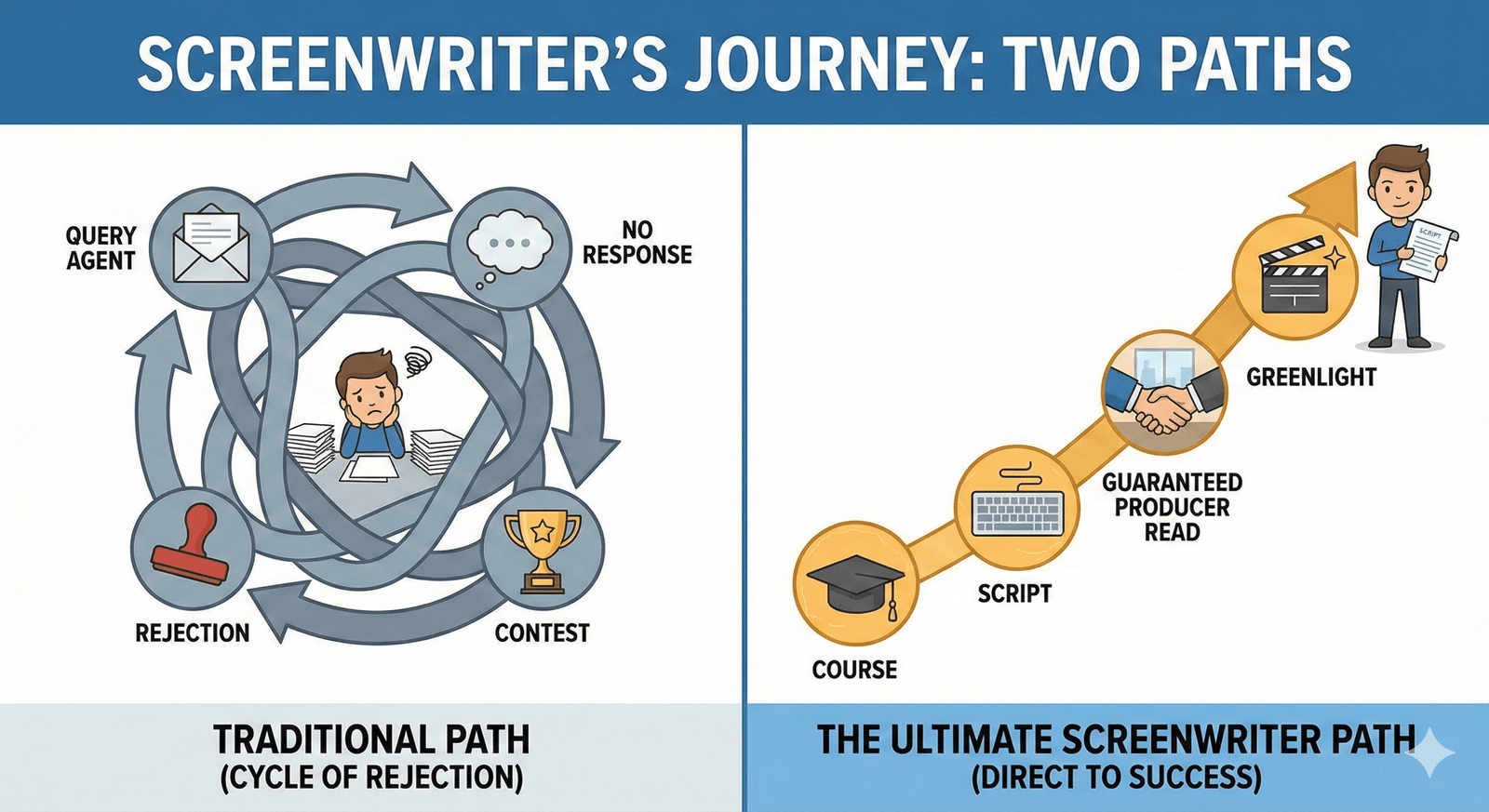
This creates a frustrating "closed loop" for newcomers:
- You can’t get a producer to read your work without an agent.
- You can’t land an agent unless a producer is already interested in your script.
The Writers Guild is a union, not a literary agency, so they won't help you submit material. While registering your script with them proves you wrote it, it is not a pathway to production.
Standard advice tells you to spend years querying boutique agencies or entering endless contests, praying you’re the lucky lottery winner. But relying on luck is not a business strategy.
Treat Your Script Like a Financial Asset
To survive this landscape, a mindset shift is required. You are a supplier, not just an artist. Producers are entrepreneurs searching for a product they can finance and package.
When a producer picks up a script, they aren’t just looking for a compelling story; they are assessing whether the project can attract capital. They possess the funding networks, but they can only activate those networks with a viable script as the foundation.
The 10-Page Rule
This reality makes your opening pages the most critical metric of all. In the high-volume world of film development, time is the rarest commodity.
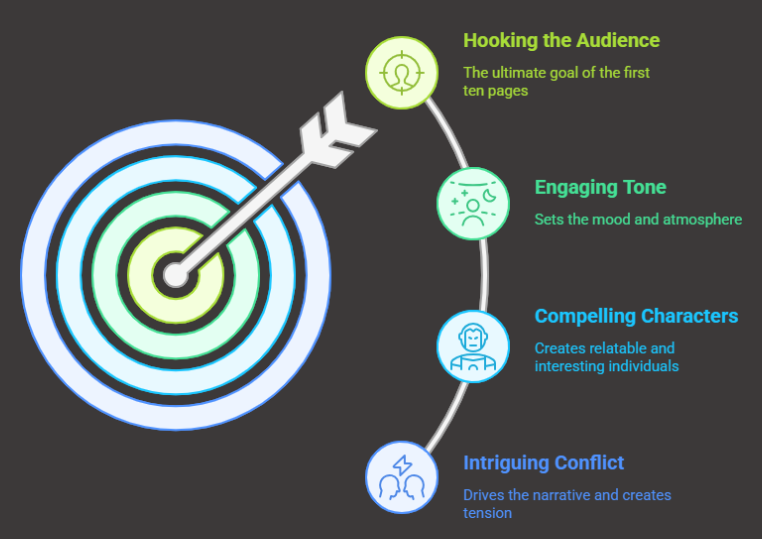
Producers rarely read a script from start to finish unless they are absolutely captivated. The verdict is usually rendered within the first ten pages—roughly ten minutes of screen time to accomplish the following:
Hooking the Audience: The first ten pages are often referred to as the "hook." They must engage the reader, establishing tone, character, and conflict. A strong opening can make the difference between a script being read or discarded.
Establishing Voice and Style: This section of the screenplay allows the writer to showcase their unique voice and style. It sets the stage for the narrative and gives readers a taste of what to expect.
Character Introduction: Key characters are typically introduced within these pages. Their motivations, desires, and conflicts begin to unfold, creating a foundation for the story.
Setting the Stakes: The initial pages should hint at the stakes involved in the narrative. What challenges will the characters face? What is at risk? This creates a sense of urgency that propels the story forward.
Creating Emotional Resonance: A well-crafted opening can evoke emotions, drawing readers into the narrative. This emotional connection is vital for keeping the audience invested in the story.
Crucial Distinction: A coverage reader’s job is to read and grade the whole script. However, even they know by page ten if it’s a pass or a recommend. More importantly, coverage readers cannot greenlight a film. Producers can greenlight a film, but they generally won't read past page ten unless the writing compels them to.
If your pacing drags, your formatting is amateurish, or your concept is muddy, your script hits the "pass" pile immediately. A brilliant climax on page 90 is irrelevant if the reader stopped caring on page 8.
This is where academia often fails. Film schools tend to reward experimental structures and "slow burns". The actual marketplace rewards professional execution and immediate engagement.
The Strategic Shortcut: The Ultimate Screenwriter Course
Screenwriting is often dismissed as a fantasy career, but it is actually one of the most scalable IP "side hustles" in the modern economy. It requires no inventory, no office, and no expensive gear—just a laptop and a concept.
The barrier has always been the gatekeepers: the managers, agents, and execs who make it impossible for outsiders to get noticed. The Ultimate Screenwriter Course disrupts this model.
It isn't designed to teach film theory; it’s designed to teach the business of writing sellable screenplays. The curriculum is taught by its creator, Emmy-nominated veteran Ron Osborn (credits include The West Wing and Meet Joe Black) and is reverse-engineered from market realities. It focuses heavily on the structural beats and polish needed to survive the "10-page guillotine". As Osborn says, “It’s called Show Business for a reason”. The course treats writing as a professional trade focused on a transaction.
However, the course’s biggest asset isn't just the education—it’s the guaranteed Hollywood producer access. Recognizing the "agent catch-22," the program offers a contractual promise: Finish the curriculum and your script, and an active Hollywood Producer will read your first ten pages.
No Networking Needed: You don’t need to move to L.A. or have famous relatives. The course leverages its own established connections for you. This democratizes the industry, allowing talent from anywhere in the world to get a foot in the door. This isn't a peer review; it is direct access to a decision-maker with the power to option your work. It effectively unlocks the door that a $200,000 degree leaves bolted shut.
The results are significant: approximately 19% of recent graduates have had their projects funded, a number that far exceeds industry averages.
Future-Proofing: AI and the Human Element
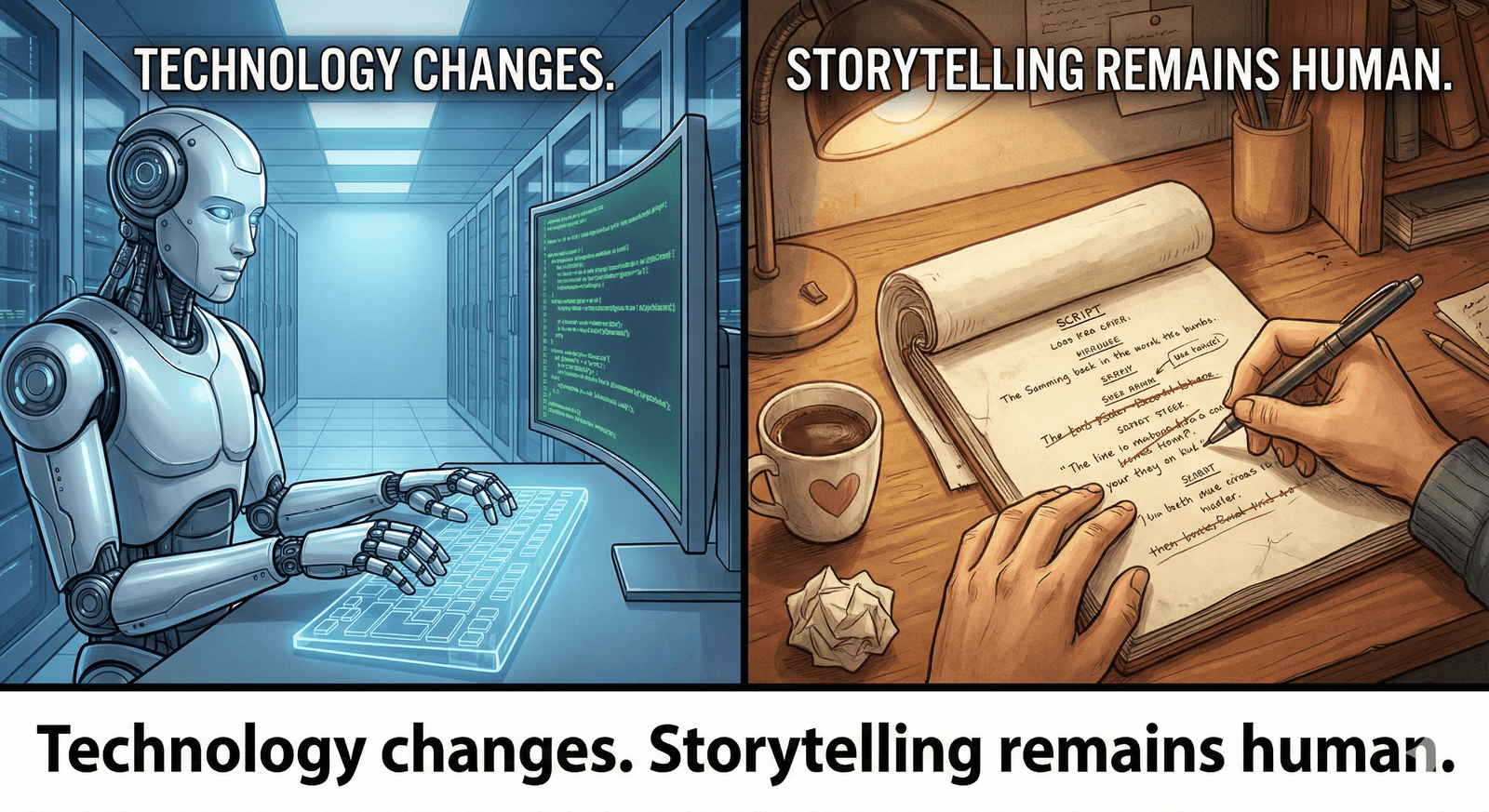
For those worried about generative AI, the question is obvious: Why write if a bot can do it?.
Oscar-winner Ben Affleck provides the answer: AI is a tool for imitation, not creation. Speaking at the 2024 Delivering Alpha summit, Affleck described AI as a "craftsman" that can mimic style but lacks the "taste" necessary for art. "AI can write you excellent imitative verse that sounds Elizabethan, it cannot write you Shakespeare," he noted.
Constructing a narrative is a nuanced, deeply human process requiring intuition that algorithms simply don't have. AI cannot replicate human experiences like love, pain, or redemption in a way that truly resonates.
However, AI will reshape production. Affleck predicts it will lower costs by handling labor-intensive tasks like visual effects. This actually lowers the barrier to entry, making it easier for new voices to produce films like Good Will Hunting on a budget.
The Ultimate Side Hustle (With Residuals)
You don’t have to sleep on a floor in Los Angeles to make this work. Screenwriting is the premier side hustle for the 2026 economy.
Low Entry Fee: The Ultimate Screenwriter Course is just $249 USD for the full 12-lesson curriculum and the guaranteed producer read. Mentoring adds-ons are available to help polish your script before submission.
Zero Overhead: No shipping, no inventory, no subscription fees. Just you and your computer.
Massive ROI: A professional sale can net up to $2,000 per page. For a standard 100+ page script, that’s over $200k for a document written in your spare time.
Let’s compare the economics:
Option A: The University Path
Cost: $40,000 - $200,000+.
Time: 4 Years.
Outcome: A degree, massive debt, a network of unemployed peers, and zero guaranteed access to funding.
Option B: The Ultimate Screenwriter Course
Cost: $249 USD (plus optional mentorship).
Time: Self-paced (months, not years).
Outcome: A finished script, craft mastery, and a guaranteed read by a producer with buying power.
The "Infinite Glitch" (Residuals): Here is the secret weapon. When you sell to a WGA signatory and get produced, you aren't just paid once. You unlock residuals—cheques that arrive in your mailbox every time your movie is streamed, sold overseas, or played on TV. It is the holy grail of passive income. Compared to driving for Uber or drop-shipping, you are creating a lottery ticket where you control the numbers.
A New Roadmap for the Self-Starter
If you want a career path without lifetime debt, or a side hustle with massive IP potential, here is the clear path forward:
- Treat Writing as a Trade: Learn the industry-standard structure and formatting.
- Master the Guillotine: Use the course to perfect your "First Ten Pages".
- Protect Your Work: Register with the U.S. Copyright Office and the WGA ($20) to create a paper trail.
- Bypass the Gatekeepers: Don't waste time querying agents who won't respond. Use the course’s guarantee to skip the slush pile and get your script directly to a producer who can finance it.
- Understand the Sale: Know that "selling" often begins with an "option"—a payment that gives a producer the right to secure financing for your project.
Don't Wait for Permission
The barriers in Hollywood are largely artificial, maintained by legal fear and tradition. With a polished script and guaranteed access, you can bypass the entire system.
You have two choices: Spend years sending emails into the void, hoping to be "discovered" by a system built to ignore you, or invest in a program that hands you the keys to the castle.
Stop writing for no one. Learn the business, perfect your craft with Ron Osborn, and get your script onto a producer's desk. The gatekeepers are still there, but with the right strategy, you can walk right past them.
Stop waiting for permission. The industry won't give it to you. Learn the trade, tighten your script, and get it read. The Ultimate Screenwriter Course is your way to sneak past the guards.

Written by: Ultimate Screenwriter
The Ultimate Screenwriter Course is an online screenwriting masterclass specializing in business-focused training and guaranteed Hollywood producer access for aspiring screenwriters looking to sell their work.