The image of the Hollywood producer is often romanticised. We imagine them lounging by a pool, leisurely reading scripts while sipping a cocktail.
The reality is far less glamorous and far more brutal.
Picture this instead: A producer sits at a desk buried under a mountain of paper.
Or, more likely in 2026, they are staring at an iPad with hundreds of unread PDF files in a folder marked "Weekend Read."
They are knackered. They are overworked. They have investors breathing down their necks, directors demanding budget increases, and agents calling every five minutes.

And then there is your script. It is sitting in that digital pile, waiting for its turn.
When the producer finally opens your file, they aren't looking for a reason to say "yes."
They are looking for a reason to say "no." They are looking for a reason—any reason—to stop reading so they can move on to the next one and get home to their family.
This is the harsh reality of the "Slush Pile." In this environment, you do not have the luxury of a "slow burn."
You do not have thirty pages to "set the mood." You have ten pages. Ten minutes.
Based on a survey we conducted among active producers and professional coverage readers, the consensus was overwhelming: they know within the first ten pages whether a script has promise or whether it is a hard pass.
This reality has given rise to what we call The Ten Page Protocol.
It is the single most important strategy for a new screenwriter.
If you cannot win the reader in the first ten pages, the other 100 pages simply do not matter.
The Psychology of the Producer: Why They Stop Reading
To master the Ten Page Protocol, you must first understand the psychology of the person holding your script.
Producers act as the "entrepreneurs" of the film industry. They are the ones responsible for finding, securing, and managing the funding for a screenplay.
When they read a script, they aren't just looking for a good yarn; they are looking for a business asset.
They are asking themselves, "Can I sell this? Can I package this? Will an A-list actor sign on for this?".
Experienced producers develop a sixth sense for material. Just as a mechanic can tell an engine is broken by the sound it makes when it turns over, a producer can spot a lack of craft, a weak voice, or a derivative concept within the first few paragraphs.
If a producer is bored on page five, they unconsciously assume they will be bored on page fifty.
And because their time is their most limited resource, they won't stick around to find out if they are wrong.
They will close the file, and your script will be dead.
The maths is simple. One page of a screenplay equals roughly one minute of screen time.
The first ten pages represent the first ten minutes of the movie. Think about your own viewing habits.
When you browse Netflix or Amazon Prime, how long do you give a movie before you click away? Ten minutes?
Five? Maybe even less.
If the movie hasn't grabbed you by the time the popcorn is ready, you switch to something else.
Producers do the exact same thing with scripts. If you haven't engaged them in the first ten minutes—the length of a YouTube video or the cold open of a TV show—you have lost the audience.
And in this case, the audience is the buyer.
The 80/20 Rule: A Strategic Application
The Pareto Principle, commonly known as the 80/20 rule, states that for many outcomes, roughly 80% of consequences come from 20% of the causes.
In business, 80% of sales come from 20% of clients.
In software, 80% of crashes are caused by 20% of bugs.
In screenwriting, we can adapt this rule to save your career.
Mathematically, 20% of a standard 110-page screenplay is roughly 22 pages.
But the decision-making process is even more front-loaded than that.
In the high-stakes world of script submission, 80% of your script's fate is decided by the first 10 pages.
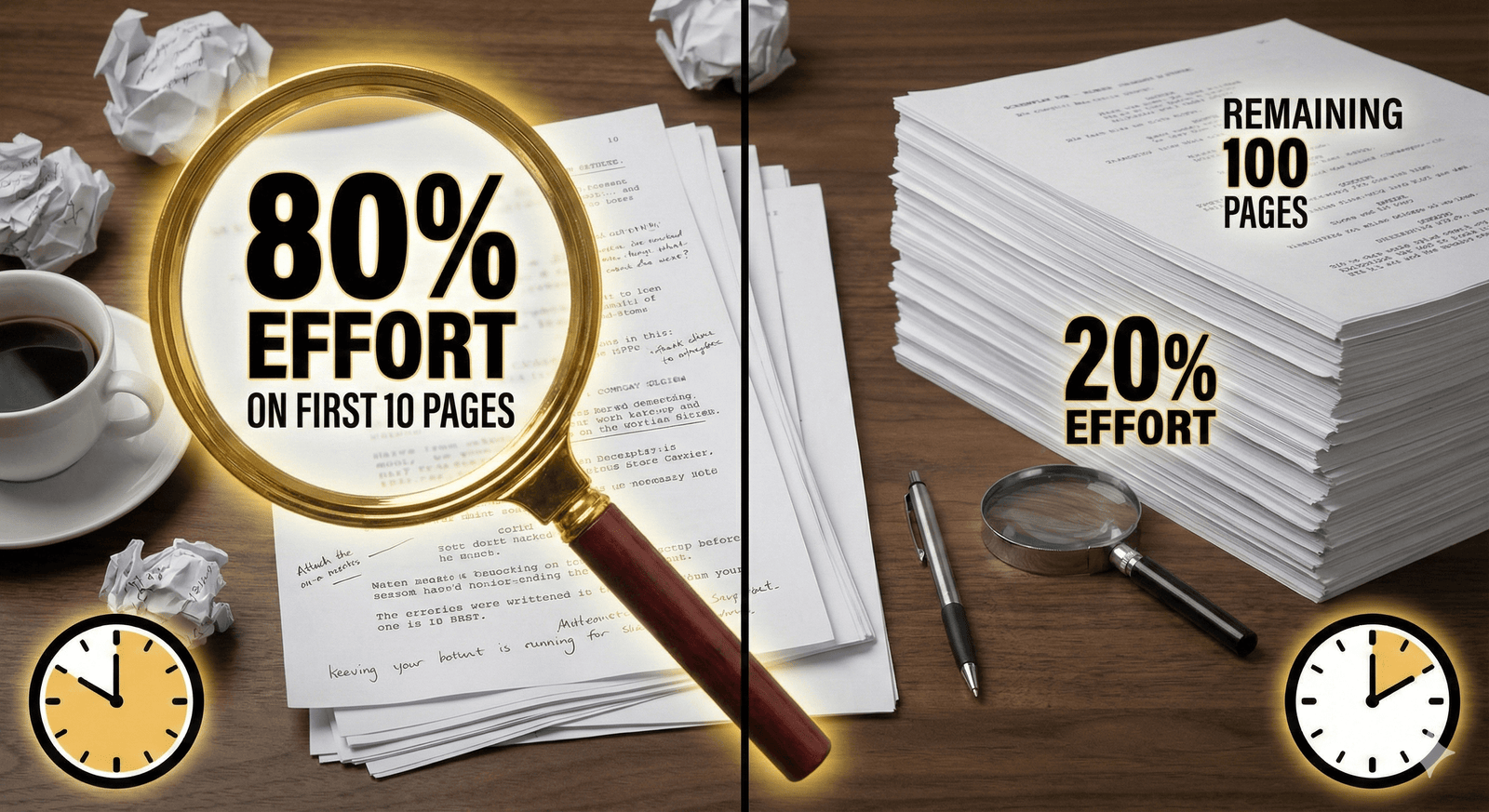
This disproportionate impact requires a disproportionate allocation of effort.
Most amateur writers spread their effort evenly across the script.
They trudge through the opening, saving their best ideas, their sharpest dialogue, and their most explosive scenes for the midpoint or the climax.
They think, "Wait until they get to the twist on page 60! That's when it gets good."
This is a fatal strategic error. The most brilliant twist on page 60 is functionally useless if the producer stopped reading at page 12. It’s like hiding a diamond inside a locked safe and throwing away the key.
The Strategy: You must front-load your brilliance. You should put 80% of your polishing, refining, and creative energy into making those first ten pages undeniable.
This doesn't mean the rest of the script can be rubbish.
It means the first ten pages must be exceptional. They must be bulletproof.
Every line of description must be evocative. Every line of dialogue must have subtext. The pacing must be relentless.
You are not just telling a story; you are making a sale.
You are selling the rest of the script.
The Anatomy of a Perfect Ten Pages
So, what exactly needs to happen in this ten-page window to satisfy the protocol?
You can't rush the story, but you must be efficient.
The survey data from our producers suggests four key elements must be established immediately:
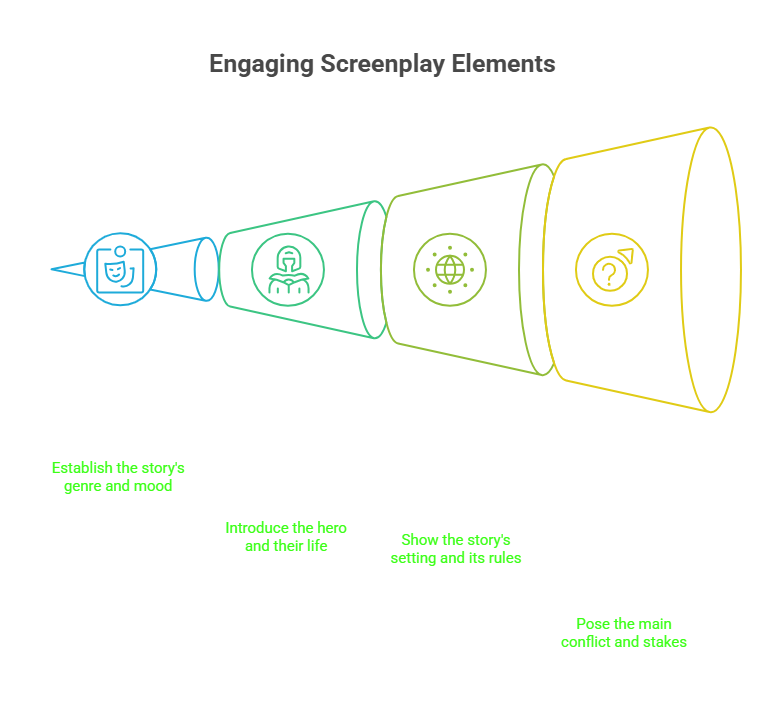
1. Genre and Tone
Confusion is the enemy of engagement. If a producer reads five pages and doesn't know if they are reading a comedy, a thriller, or a drama, you have failed.
By page five, the reader must feel the genre in their bones.
If it is a comedy, they should have laughed out loud at least once.
If it is a horror movie, they should feel a sense of dread.
If it is an action movie, their pulse should be elevated.
The tone acts as a promise to the reader: "This is the ride you are on."
2. The Protagonist's Status Quo
We need to meet the hero, and we need to care about them. But "caring" doesn't mean "liking."
You don't need a "Save the Cat" moment where the hero does something saintly.
You just need empathy and understanding.
We need to see their "Status Quo"—what their life looks like before the movie starts.
What do they want? What is missing from their life? What is their flaw?
We need to establish a baseline of normalcy so that when the inciting incident hits, we understand why it matters.
3. The World Rules
Whether your story takes place in a coffee shop in Melbourne or a mining colony on Mars, the rules of the world must be established without bogging the story down in exposition.
Amateur writers often make the mistake of "data dumping" in the first ten pages—stopping the story to explain the history of the war, the magic system, or the family tree.
Don't do this. Show the world through action. Let the reader learn the rules by watching the characters navigate them.
4. The Hook (The Central Dramatic Question)
While the true Inciting Incident (the event that locks the hero into the journey) often happens around page 12 or 15, the hook must happen earlier.
The "Central Dramatic Question" must be posed.
The reader needs to know what the movie is about.
Is this a story about a man trying to survive a shark attack?
Is this a story about a woman trying to win back her ex? The stakes must be clear.
If the producer is on page nine and still asking, "So, what is the plot?", you are in trouble.
The "Car Crash" Standard
It is not enough to simply be "competent." Competence gets you a polite pass.
To get a "Recommend," you need to be compelling.
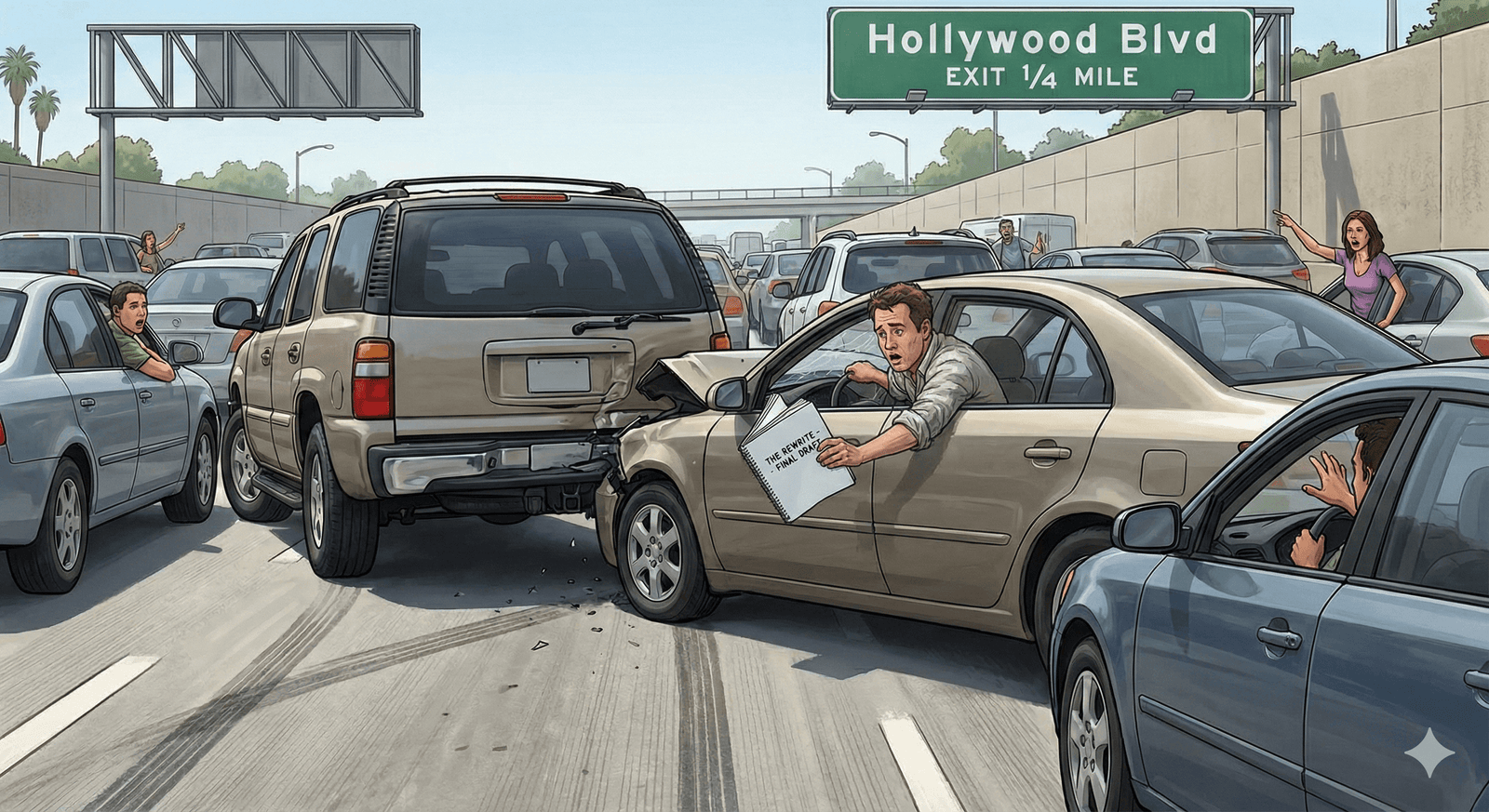
Ron Osborn, the Emmy-nominated screenwriter and instructor of The Ultimate Screenwriter Course, has a specific metric for this.
He calls it the "Car Crash Standard."
His advice is simple: "Those first ten pages should be so engaging that if the producer is reading your script in traffic, they crash into the car ahead of them."
This sounds like hyperbole, but it is the level of engagement you must aim for.
You want to create a "lean-in" moment. You want the external world—the traffic, the office noise, the emails—to disappear for the reader.
Does this mean you need a literal car crash or an explosion on page one? Absolutely not.
"Engaging" does not always mean "high octane." A quiet conversation between two people in a diner can be a car crash moment if the subtext is lethal.
A scene of a character sitting alone in a room can be gripping if the tension is high enough.
It is about intrigue. It is about creating a question in the reader's mind that they must have the answer to.
"Why is she lying?" "What is in that box?" "Who is the man in the corner?"
The moment the reader asks a question, they are hooked. They will keep reading to find the answer.
Your job in the first ten pages is to open loops that the reader is desperate to close.
What to Avoid: The Red Flags
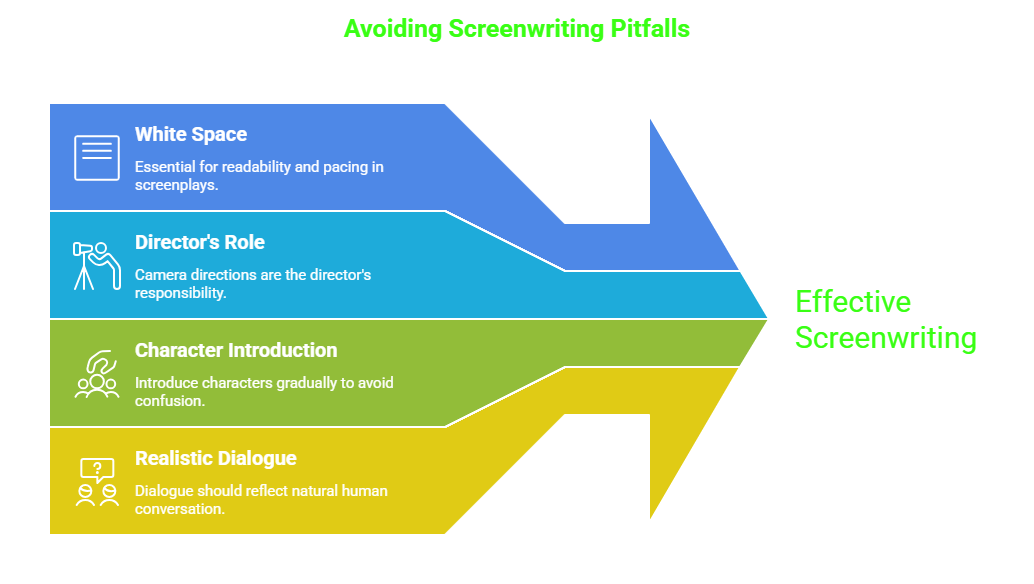
Just as there are things you must do, there are things that will instantly kill your script in the first ten pages.
These are the red flags that coverage readers look for to justify a quick rejection.
Blocks of "Black Ink": Giant, dense paragraphs of action description that look like a novel.
Screenwriting is about white space. It should be fast and readable.
If a producer sees a wall of text, their eyes glaze over.
Camera Directions: Avoid writing "CAMERA PANS LEFT" or "ZOOM IN ON WATCH." That is the director's job, not yours.
It breaks the immersion and makes you look like an amateur.
Character Soup: Introducing six characters in the first three pages. The reader cannot keep track of them.
Introduce your core players one at a time.
On-the-Nose Dialogue: Characters saying exactly what they are thinking or feeling.
"I am so sad that my wife left me." Real people don't talk like that; they talk around their feelings.
The Ultimate Screenwriter Solution
Understanding the Ten Page Protocol is one thing; overcoming it is another.
Most film schools and online courses teach you how to write a three-act structure.
They teach you about character arcs and theme. These are important, but they ignore the gatekeeper.
They teach you to write for the theatre, not for the "Slush Pile."
The Ultimate Screenwriter Course is different because it is built around the reality of the business.
We acknowledge the Ten Page Protocol, and we have built our entire curriculum—and our guarantee—around it.
We know that getting a producer to read your script is the hardest part of the job.
Unless you have a personal connection to a decision-maker, it is nearly impossible.
That is why we offer a guarantee that no other school offers: An active Hollywood producer will read the first ten pages of your screenplay.
We don't just teach you the 80/20 rule; we put it to the test.
We force the door open for you. We guarantee that your "hook"—the ten pages you have spent 80% of your effort perfecting—will be seen by someone with the power to greenlight a movie.
Once they are reading, the rest is up to you. But getting them to read those first ten pages?
That is the hurdle that stops 99% of writers. We remove that hurdle.
Conclusion: You Have Ten Minutes to Win a Career
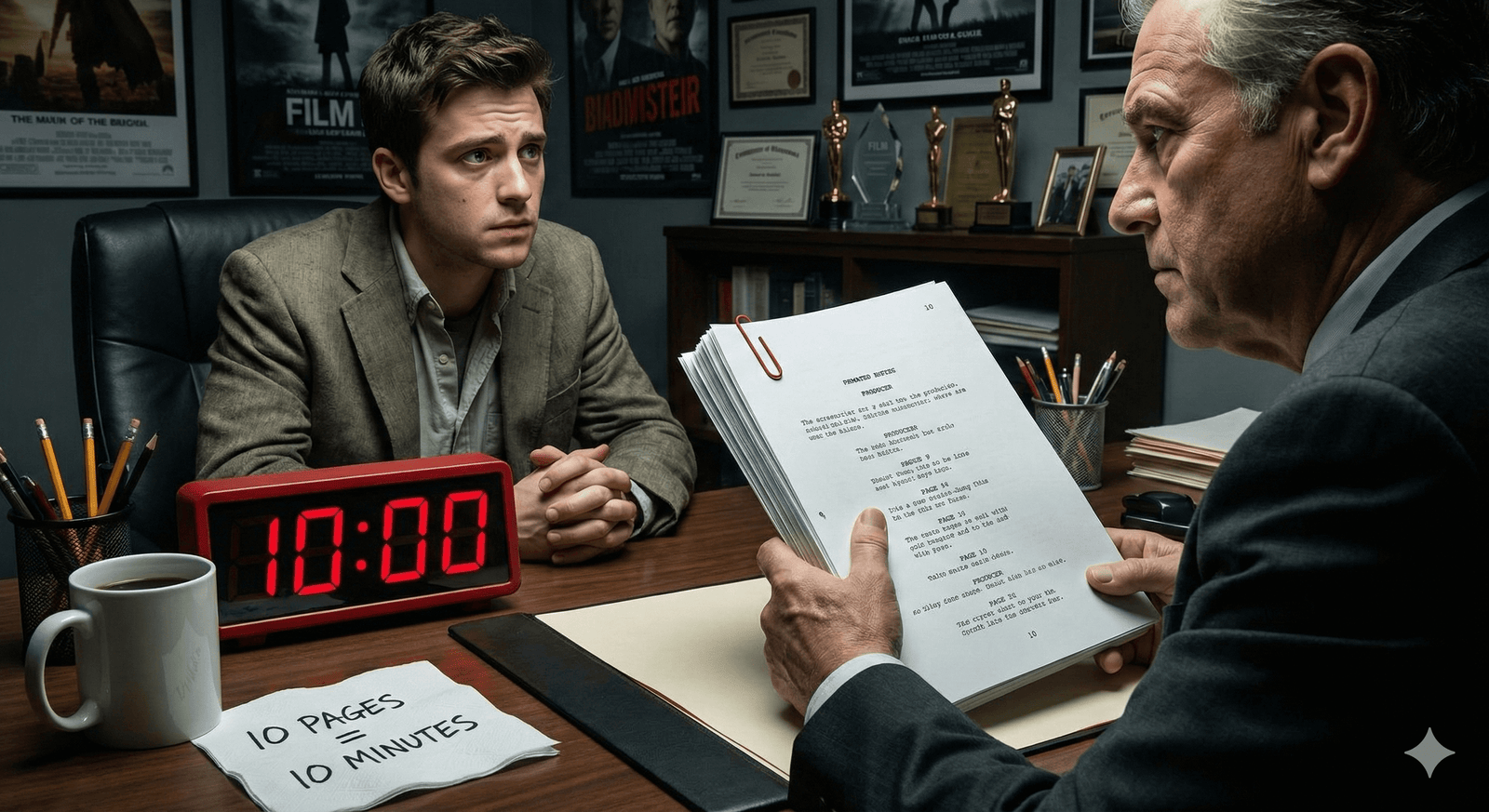
The film industry is not fair. It is not a meritocracy where the best story always wins.
It is a business of time management, risk assessment, and quick decisions.
The producer reading your script is looking for a reason to stop.
Your job is to make it impossible for them to do so.
The first ten pages of your screenplay are not just an introduction. They are a sales pitch.
They are an audition. They are a promise. They are the 20% of the work that yields 80% of the results.
Don't just write a script. Write a "car crash." Master the Ten Page Protocol.
Put 80% of your sweat into those first ten minutes.
Because if you can hold a producer's attention while they are stuck in traffic on the 405, you haven't just written a scene—you've launched a career.
Written by: Ultimate Screenwriter
The Ultimate Screenwriter Course is an online screenwriting masterclass specializing in business-focused training and guaranteed Hollywood producer access for aspiring screenwriters looking to sell their work.