
We love the myth of the lone genius. We picture the writer toiling away in a dimly lit room, fueled by coffee, typing "FADE OUT" on a masterpiece that changes the world.
It’s a romantic image. It’s also a lie.
While the act of writing is solitary, the act of succeeding in Hollywood is a team sport.
The film industry is a fortress. It has high walls, deep moats, and heavy gates that are locked from the inside. Talent might get you to the gate, but connections are what get you inside.
For a new screenwriter, working with a mentor isn’t just about improving your script; it is about accelerating your career. It is the difference between learning from your own mistakes—which is a brutal grind—and learning from someone else’s wins.
A Tried and True Tradition
Mentorship isn't a new fad. It is the fundamental way craft has been passed down for centuries. In the Renaissance, you didn't just decide to be a painter. You became an apprentice.
Hollywood was built on this exact same system. Writers were often hired as "junior writers" and paired with veterans to learn the ropes.
The industry knows that talent is raw material. It needs guidance to become a finished product.
Street Smarts vs. Book Smarts: Experience Beyond the Classroom

This is where traditional film school often falls short. Universities are excellent at teaching theory. They can teach you the history of cinema. They can teach you formatting. They can teach you how to write.
But a mentor teaches you how to be a writer.
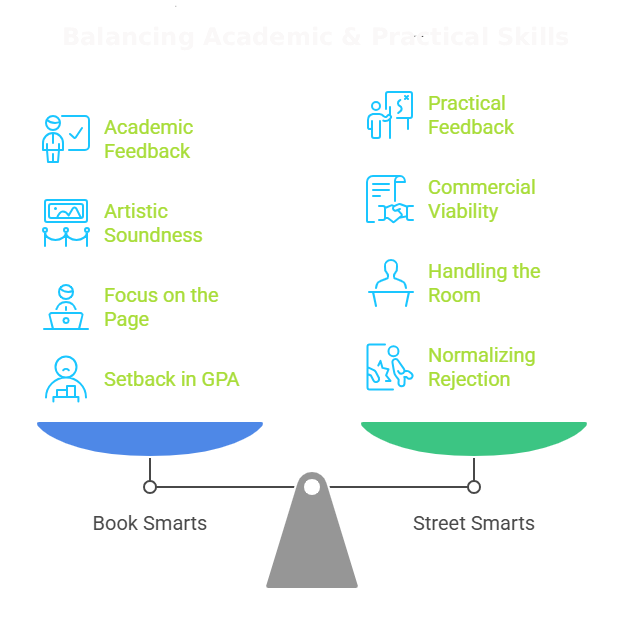
There is a massive difference between "book smarts" and "street smarts." A professor grades your script based on academic criteria; a mentor tells you why a producer will toss it in the bin on page ten. Mentors provide the context that textbooks cannot. They teach you how to navigate the politics of a writers' room and how to take notes without being a keener about it.
Here is the breakdown:
1. The Feedback Loop
Book Smarts (Uni): You receive a grade on your script. You have weeks to fix it.
Street Smarts (Mentor): You receive "notes" from a producer that seem contradictory. A mentor teaches you how to decode those notes and execute a rewrite in 48 hours without losing the soul of your story.
2. The Definition of "Good"
Book Smarts (Uni): A "good" script is artistically sound and deep.
Street Smarts (Mentor): A "good" script is one that gets sold. A mentor teaches you that sometimes "good" means "marketable".
3. The Pitch vs. The Page
Book Smarts (Uni): It's all about the words on the page.
Street Smarts (Mentor): The script is only half the battle. A mentor teaches you how to pitch your idea in 60 seconds to a bored exec checking their phone.
4. Resilience and Rejection
Book Smarts (Uni): Failure is getting a C-. It’s a setback.
Street Smarts (Mentor): Failure is Tuesday. A mentor teaches you that hearing "no" ninety-nine times is just part of the process.
At The Ultimate Screenwriter, our mentors aren't just teachers; they are active, established pros.
The Golden Rolodex: Access and Connections

There is a cliché in Hollywood: "It's not what you know, it's who you know." People repeat it because it is true.
Without connections, you are fighting a mathematical impossibility. A mentor is a bridge over that moat. They don't just give advice; they give access.
When a script is submitted by a known mentor, it skips the "slush pile." It arrives with a stamp of approval. That validation is currency.
The Business of Art: Making a Living
Many talented writers fail not because they can't write, but because they treat screenwriting as a hobby rather than a business. Mentors have successfully cracked the code of paying their mortgage with their creativity. They understand that you are not just an artist; you are the CEO of a small business called "You, Inc."
The Ultimate Screenwriter Solution: 1-on-1 Professional Mentorship
At The Ultimate Screenwriter Course, we understand that guidance is just as important as the curriculum. That is why we offer private 1-on-1 mentorships as an exclusive upsell to all our students.
This opportunity is timed to happen after you complete the third lesson.
Why then? Because by lesson three, you have the fundamentals, but you haven't yet submitted your work to the "wolves." This is your safety net. It allows you to get your burning questions answered and fix your script BEFORE you submit your first ten pages to our Guaranteed Producer Read.
This ensures you aren't burning your opportunity with a rough first draft. You are submitting a polished, vetted product that has already been stress-tested by a professional.
While this mentorship is optional, the results speak for themselves: Over 80% of our graduates who successfully got their projects funded used our mentoring services.
These successful students didn't just write one draft and hope for the best. They averaged well over three rewrites based on professional advice.
Conclusion
You have two choices. You can try to navigate the maze of Hollywood alone, hitting dead ends and learning hard lessons on your own dime. Or, you can hire a guide who has already mapped the territory.
Don't just learn to write; learn to succeed. Connect with mentors who have the credits and the connections. Because in this industry, the shortcut to success isn't a trick—it's a mentor.
Written by: Ultimate Screenwriter
The Ultimate Screenwriter Course is an online screenwriting masterclass specializing in business-focused training and guaranteed Hollywood producer access for aspiring screenwriters looking to sell their work.